Posts

Showing posts with the label Iraq

Beautiful from Space Only

Image
The European Space Agency (ESA) has released today a satellite image of southern Iraq taken September 14, 2008. It shows an enormous sand storm which apparently did not affect Kuwait, as I checked right now. Weather Underground (my favorite weather forecast site) had reported weather and 45 centigrades maximum temperature that very day. Still rather hot, I suppose. Kuwait had been plagued by a large number of sandstorms this year. I remember 2003 when military activity in the north of the tiny Gulf state was made responsible for numerous sandstorms which occurred from April through June. They usually develop when large amounts of cold air moves across dry ground, which is covered by loose sand or salt. They inevitably impair quality of air and may cause asthma attacks or even bronchitis and conjunctivitis. Even the immune defense might be affected.

The Ikaros of the Persian Gulf

Image
This is (almost) the title of a wonderful production of Tareq Rajab Museum , written by Mr. Rajab’s wife Sehan in 1999. When I had moved to Kuwait in 2001, the island, about 20 km east of the shores, mesmerized me from the beginning. Interested in the archaeology of the region, the at least two archeological sites there, one from the Bronze Age and a small Greek Temple dating to Alexander the Great, immediately attracted my attention. Amazingly, none of my new colleagues had visited the island and very few others I asked had ever been there. It was said that it was no longer inhabited since the Iraqi invasion and expulsion in 1991. I was told that there was a ferry boat from Ras Salmiya every now and then. So, I decided to make a trip on the first Eid holidays after I had settled in Kuwait. The Island was first mentioned by Greek geographer Strabo (d. 25 CE). The Greek, who had built an outpost on the island during Alexander’s conquest of Asia (336-323 BCE), called it Ikaros...

Standard Operating Procedure

When this happened I visited Damascus where I got to know an Iraqi professor who was visiting the city too. The shocking pictures induced considerable disturbance, and I have reported on that almost significant emotional event some time ago. President G. W. Bush apologized for the mistreatment of detainees in Abu Ghuraib on May 6, 2004. But that was not well-perceived in the Arab world. Shockingly, the American hostage Nicholas Berg was beheaded one day later by the dastard slayer Abu Musab al-Zarqawi . I remember the horrible video which immediately circulated on the internet. And that I was more or less forced to see it by an Arab colleague who obviously wanted to teach me, the Westerner, a lesson. Zarqawi was killed in a US bombing raid exactly 2 years ago. Berg's assassination added a new, indeed catastrophic, dimension to the war in Iraq. The award winning semi-documentary Standard Operating Procedure by Errol Morris can now be seen in movie theatres throughout Europe. Thi...

Leading to War

Image
On the eve of feared new military adventures in the Middle East and five years after the bombing of Baghdad see the movie Leading to War here . From the web page: SYNOPSIS of THE FILM How does a government lead its people to war? How does it communicate to its citizens – and to the wider world – the reasons and rationale for initiating military conflict? What rhetorical devices and techniques are employed? And how is a nation brought to support the profound decision to wage war against another nation? These are the questions that LEADING TO WAR seeks to explore. This 72-minute film shows the evolution of the United States government’s case for military action against Saddam Hussein’s regime, leading to the Iraq War which began in 2003. LEADING TO WAR is comprised entirely of archival news footage – without commentary, without voiceover – presented chronologically from President Bush’s State of the Union address in January, 2002 (the “axis of evil” speech), and continuing up to the ann...

Sunnis and Shiites

Participants at the latest Doha Debate on April 29th, 2008 have strongly defended Islam's image after repeated accusations that it had been damaged by the Sunni-Shia conflict in Iraq. The motion that the Sunni-Shia conflict is damaging Islam’s reputation as a religion of peace was defeated by 61%-39%. From the Doha Debate webpage: In a series of robust exchanges, there was strong disagreement about the effects of violence between Islam's two largest denominations. Juan Cole, Professor of History at the University of Michigan, said recent polls showed that Americans believed Islam contained more violent extremists than other religions and sectarian fighting must have contributed to that impression. “People in the United States are beginning to see Muslims as inherently violent,” he said. This perception, he argued, enabled the major powers to exploit Islam's splits “and embark on a policy of divide and rule.” Seconding the motion, General Ali Shukri, an adviser to the late K...

Mission Accomplished

May 1, 2003

The Guernica Tapestry

Image
When I recently watched again the BBC production Around the World in 80 Treasures , I stumbled over the remark by Dan Cruickshank about the tapestry copy of Pablo Picasso's Guernica in the United Nations building in New York City. When Collin Powell and John Negroponte delivered (now it is clear to everyone) their lies about Saddam Hussein’s weapons of mass destruction in a press conference on February 5, 2003, the picture was veiled with a large blue curtain. Guernica from 1937, which is an epoch-making reminder of the horrors of war (we recall that German and Italian fascists, in what was called Operation Rügen, killed, in several raids, hundreds of innocents), should not interfere with media coverage when war had been declared on the Iraqi people. http://www.slate.com/id/2078242/

Ancient Civilizations

Image
When writing about my visit at Kashan’s Tappeh-ye Seyalk in 2005 , I have to stress that most of the treasures excavated there in the 1930s found their way to The Louvre, The Metropolitan Museum of Art in New York, The British Museum. Sadly, some even went to private collections. Some years ago, a similar looting took place in Shahr-e-Sookhte near Jiroft, well before scientific excavations could start at the site in 2001. When visiting Tehran’s National Museum in November last year, I saw only a replica of the stele with Hammurabi’s (1728-1686 BC) Code. The original is on display at The Louvre. I am afraid that most of the treasures of the Cradle of Civilization, i.e., Iran, Iraq, can be seen in the museums of the West nowadays. These days the fall of Baghdad marks its 5th Anniversary. Among some very negative impressions was the looting of Iraq’s National Museum while US troops didn‘t do too much to prevent it. According to Gen Richard Myers, chairman of the Joint Chiefs of Staff, ...

One Year Ago

We have not forgotten that presidential candidate Senator John McCain "was just trying to add a little humor to the event" , as his spokesman Kevin McLaughlin told news agencies later. It was about one year ago at Murrels Inlet VFW Hall in South Carolina , and McCain was asked when he thought the US Military might "send an air mail message to Tehran." In view of the recent mix-up by the Senator of Al-Qaeda and Iran, when touring the Middle East showing his competencies and when responding to General David Petraeus' testimony about the current situation in Iraq to the Congress , we are still rather concerned about his further actions once the American people have elected him their next President.

Back From San Antonio

Image
These days, the so far 3rd war (not the second!) in the Gulf region marks its 5th anniversary. The operation was called Shock & Awe and I was watching the bombing of Baghdad live on my TV in a flat in Kuwait. Incredible, Baghdad and its avenues at the Tigris river were brightly illuminated when the first bombs blasted! It looked more like a Hollywood movie. How could that be broadcast to the World? While we were sitting here in a totally dark, blacked-out Kuwait! I really can tell, I was shocked and awed. We had spent the last days before the outbreak of war with shopping of the special kind, hoarding meat, tuna fish and vegetables in cans, getting large amounts of rice and noodles, buying candles. Our former Faculty Dean had briefed the brave of us, who were about to stay, in one of the then rare Faculty meetings: There might be curfews in Kuwait. The Americans troops will be in Baghdad within 72 hours. University will be closed for a week or so. Life will go on. But the...

They’ll Never Forget!

Image
On the 2nd of August 1990, Kuwait, the small country in the corner of the Persian Gulf was invaded by Iraqi troops. The tanks overran the tiny post at Abdaly, about 50 km north of the Al Mutlaa ridge. Saddam Hussein was pretty certain that the US would not interfere. He had enjoyed, for many years, a sort of friendship among rogues, and the handshake with Donald Rumsfeld is unforgotten, when the first war in the region, against America’s arch-enemy Iran, culminated with poison gas on one side and children with little plastic keys sent into the mine fields on the other. Stunningly, both parties, Iraq and Iran, had been eagerly supported by the West. Israel had even sold arms to Iran. It was a worldwide desire that both bastards, Saddam’s and Khomeini’s regimes, should better bleed to death, and vanish. But dictatorships do not vanish easily. One million had died when this war, which saw battles in trenches and usage of mustard gas, 70 years after WWI, ceased in August 1988. As other Ar...

Almost a Significant Emotional Event

Image
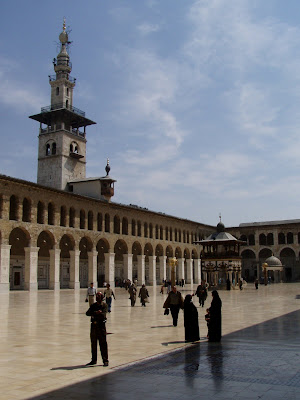
Where had I been in late April 2004? I remember (as an almost significant emotional event* ) an afternoon in Damascus. I had invited an Iraqi Professor of Geophysics to my room in the Cham Hotel. I was a tourist, and he had just brought his family with the car from Holland, where he worked, to Baghdad. Right now, he was on his way back to Amsterdam in order to quit his job and then permanently move to Iraq. He had some hope of getting a position at Baghdad University. The stopover in Damascus provided him with the opportunity of visiting some of Islam's holiest places. Dr. Saad had noticed me when entering the Umayyad Mosque, one of the most awesome buildings in the Islamic world. It was my first visit of a mosque ever, and I had been stumbling into the smooth as glass-like courtyard, when I suddenly heard his warning: “Better remove your shoes!” With an apology I did, and when I entered the gorgeous prayer hall itself, I met him again. We chatted, about Kuwait, Iraq, Holland, Germ...

Kuwait Bay

Image
Most of Kuwait Bay is lined by extended mudflats. The Bubiyan island in the Northeast is also mainly formed of mud. It is connected with the mainland by an impressive bridge but still public traffic is not permitted. The Arabian (indeed, the Persian) Gulf has only one major fresh water source, the Shatt Al Arab. Together with great heat in summer and, therefore, enormous evaporation, water is very salty, even more in enclosed bays or in intertidal pools. Nevertheless, life is abundant, and fishing may still be an important source for food. Typical Hadra traps are found in the mudflats, complicated maze of sticks in shallow waters. Fish will not be able to find a way out and will be picked by the fishermen at low tide. Another trap is Gargoor which is portable. The principle is generally the same. Fish will swim into the trap through a funnel but certainly are not intelligent enough of finding a way out. Near the Bubiyan bridge the remains of the Iraqi invasion, ruins and vessel wreck...