Posts

Showing posts with the label Cairo

Cairo, April 2011

We just returned from a short trip to Cairo. We spoke with a few people about the revolution. There is certainly hope but  not really the spirit of change. Egyptians have listened to President Obama's historical speech on June 4, 2009 in Cairo but also have noted that his words on America's support of democracy all over the world were not meant very seriously. That the revolution in Egypt is now irreversible may be an over-opimistic conclusion by Mohamed ElBaradei who might run for presidency in September but without any real chance. See his interview with Charlie Rose while promoting his new book The Age of Deception: Nuclear Diplomacy in Treacherous Times   here .
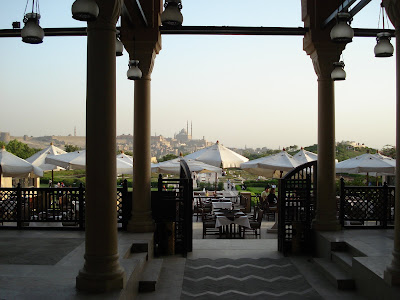
Al Azhar Park

Image
In the very heart of Cairo’s noisy and heavily polluted center, an unexpected oasis has been created, as is featured in this month’s issue of Saudi Aramco World , a daring green experiment linked to Cairo’s past. It is located on the site of a vast rubbish dump where for more than five hundred years residents had tossed away their garbage. The park is a marvelous gem, an Islamic garden, and Cairo’s green lung. The Aga Khan, Imam of the Ismaili muslims with family ties to Cairo’s Fatimid Dynasty of the 10th century, has been a main sponsor of the project. Work commenced in 1997, and in 2004 the park received its first visitors. It is amazing to read what the team of Egyptian, French, Italian, and American architects, engineers, and landscape specialists and horticulturalists uncovered when digging in the thirty meters of rubble.

Mansions in Cairo

Image
I have already reported on the beautifully restored John Gayer-Anderson house in the vicinity of the ibn Tulun mosque in Cairo. It was merged with another mansion from the 16th century, the House of the Cretan, by the British army doctor, who decorated both with furniture and collectables from all over the Middle East. So, it might not be original (although the harīm , pictured in the posting on the ibn Tulun mosque , looks pretty original) but rather represents the more or less colonial attitude of a member of the occupying force. No wonder, the house was even featured in a James Bond movie, The Spy Who Loved Me (1977). Other great mansions I visited in Islamic Cairo include Beit Zainab al Khatoun close to the Azhad mosque and the wonderful Beit al Suhani from Ottoman and Mamluk periods, respectively. A remarkably self-confident female student of Antiquities took me around and explained to me the different rooms, their functions in hot summer and cold winter and beautiful decorations,...

The City of the Dead

Image
Up to half a million people are living in one or the other of Cairo’s cemeteries. Egyptians have a millennia-old affinity to the dead. The necropolises of the Pharaohs have their contemporary counterparts in the cemeteries of the exploding city of Cairo with its supposed 20 million people. While the mausoleums’ guardians with their families have lived here for generations, new dwellers have arrived, homeless and poor, or even mad. The Northern Cemetery is a wonderful, peaceful quarter in the midst of bustling Cairo without any traffic except some donkey carts. There are small restaurants and even a police station. The cemetery is also home of the beautiful old mosque built by Sultan Qaitbey in the late 15th century. It is depicted on the 1 E₤ bank note.

One Thousand Minarets

Image
Cairo’s oldest and largest mosque which has survived during the centuries is also its nicest, that built by Ahmad Ibn Tulun at the end of the 9th century. Its single minaret resembles that of the famous mosque in Samarra in Iraq. In fact, Ibn Tulun was Iraqi. What makes the mosque so special is also its archway with dozens of pointed arches, centuries before their European Gothic counterparts. Each of these arches is decorated with different carvings. The best overview over the huge complex is provided on top of the minaret of the nearby Mosque of Sarghalmish. John Gayer-Anderson, a British military doctor, restored and furnished a private mansion very close to the mosque of Ibn Tulun. He lovingly filled the gorgeous rooms with antiquities from the Middle East. The harem for the four wives of the previous owner is particularly impressive. They were not quarreling but rather living in peace, as I asked the friendly guide through the building. The womenfolk participated in the parties ...

The Mayhem

Image
Cairo, 22 June 2008

Souq Al Gamaal

Image
A very dirty and depressing place. I wouldn’t recommend Souq Al Gamaal for a visit. We saw the pyramids when passing Giza to go north of Cairo. When we approached the site in Birqash, we saw dozens of decomposing bodies of camels, cattle, sheep, on what was a giant garbage dump. Tourists had to pay for a ‘ticket’. Incredible. Camels had been carried from Sudan, I was told, to this horrible place. Their usual fate is to be slaughtered. In order to prevent their quick escape, their left foreleg was bound, so they could only jump a bit. Young boys and men beat the beasts all the time, without any reason. My driver asked for camel milk for his sick mother in hospital. They had to milk a camel, and Ahmed was happy when he finally got the container with the milk. I spent some time with a “sheikh”, who supposedly was the boss of all of this. He showed me a year 2000 copy of a German magazine about Cairo where he and the camel market in Birqash had been featured. He was the owner of a unique ...