Posts

Marshmallow

I couldn't resist.

Mombasa's Fort Jesus

Image
Mombasa does not reveal its special charm easily. I had been in the old city before (I will report later) but was a bit disappointed. The organizers of the AMER IADR Meeting had scheduled a guided tour on Friday afternoon, and I was the first to register. Twenty-eight Euros for three hours, whow! I expected gorgeous insights into the East African societies and culture. Out we went with the bus. The group promised to be fun. In fact, we laughed a lot. A South African couple was interested in my pretty exotic experiences in Kuwait and Norway. Our first stop was at the Akamba Handicraft Industry Cooperative Society, a non-profit organization where some 10'000 people were employed who carved beautiful sculptures and small items, chairs, masks, etc. from ebony wood, Kenya's gold. Well, when entering Mombasa city we got more or less stuck in the afternoon traffic jam. Our guide seemed not to have the slightest clue what he wanted to show us. We passed the famous giant tusks but I c...

A Dokhtar-i Ghazi Prayer Rug

Image
Timuri prayer rug Dokhtar-i Ghazi design Afghanistan, 150 cm x 98 cm, old (second half of 20th century) Warp: W, Z2S, ivory, light brown Weft: W, S, ivory Pile: W, Z Knots: as1 Density: 17 x 11, ca. 187 kpsi (2900 per sq dm) Height of pile: 2 mm Handle: like velvet, grainy Upper end: - Lower end: - Sides: 0.5 cm wide, W, selvages black Colors: 5, black, dark-purple, dark blue, brown-red, ivory (beige) Classic Dokhtar-i Ghazi (the Qadi’s daughter) design. With considerable density of knots. The origin is sometimes identified as Timuri, an Afghan/Central Asian tribe which, according to George O’Bannon, does no longer exist in Afghanistan. See also a less interesting rug in R. D. Parsons’ Carpets of Afghanistan, plate 98. Good examples may be found on Thomas Cole’s page: http://www.tcoletribalrugs.com/article45YaqubKhani.html , http://www.tcoletribalrugs.com/article30PitOcts.html

A Kordish Baluch Rug from Khorassan

Image
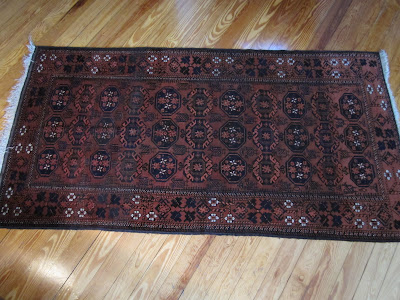
Kordish Baluch rug, Ali Mirzai design Khorassan, Northeastern Iran, 198 cm x 107 cm, old, possibly antique (first half of 20th century) Warp: W, Z2S, ivory Weft: W, S, grey Pile: W, Z Knots: as2 (asymmetric, open to the right) Density: 12 x 7, ca. 84 kpsi (1300 per sq dm) Height of pile: 3 mm Handle: thin, evenly grained Upper end: 2 cm kilim, W, 3 bands, black, red-brown, olive Lower end: - Sides: 0.5 cm wide, W, selvage dark-brown Colors: 4, black, dark-blue, brown-red, white The main field consists of octagons, alternating either filled with blossoms or with another octagon and an octagonal star. In between the main octagons, stylized cocks are displayed (note that "Baluch" is etymologically derived from cock, cockscomb, or bundle of hairs). They generally face each other with the exception of the lower row of cocks, where the second is turned. The main border has a hashie nargessi (narcissus border) design, which is very typical for the Ali Mirzai (S. Azadi, Carpets in th...

Bobbins and Bowties

Image
I have promised some time ago to describe, in separate posts, the different iwans at Esfahan’s Masjed-e Jomeh. I have discussed the southern and western iwans but political turmoil after the presidential election has largely dampened my enthusiasm of reporting on Iran’s glorious past. What has attracted my interest on the occasion of my last visit of Esfahan were some dazzling tessellations on the Darb-i Imam (1453 CE) and on the western iwan of Esfahan’s Great Mosque (about the same time) which have caused considerable discussions in the academic world. It had even been speculated whether they represent early examples of quasi-periodicity. You may find more information on it here and here . What is evident is that these complicated tilings frequently with five-fold ornament (decagons and pentagons) must have been composed of certain units which have been called girih tiles. They have conventional decoration ribbons with internal angles of multiples of 36°. You may find them in deco...

More Holy Sites

Image
I haven’t posted here for a long time (but see my other posts at Freelance where I have been pretty busy in recent months). It was mainly the Iranian election with its outcome (not surprising) and the turn into a police state afterwards. The Iranian people have a tough time right now. I have seen the new cabinet suggested to President Mahmoud Ahmadinejad the other day in a picture (they have to be approved by the majlis , but God forbid!). To be honest, none of them looks trustworthy. One is even wanted by Interpol. It’s a shame, but maybe the good people there (are there?) will reject the proposal in total. I have received a disturbing email from Iran as a response to my Ramadan Kareem greetings wanting me to pray for the people there. I will try to do that by posting another series of pictures of holy places, this time in Shiraz, the city of nightingales and roses, poets and poems, vine and paradise gardens, and beautiful girls. This post is dedicated to the friendly people in Iran ...