Posts

Showing posts with the label Egypt

Cairo, April 2011

We just returned from a short trip to Cairo. We spoke with a few people about the revolution. There is certainly hope but  not really the spirit of change. Egyptians have listened to President Obama's historical speech on June 4, 2009 in Cairo but also have noted that his words on America's support of democracy all over the world were not meant very seriously. That the revolution in Egypt is now irreversible may be an over-opimistic conclusion by Mohamed ElBaradei who might run for presidency in September but without any real chance. See his interview with Charlie Rose while promoting his new book The Age of Deception: Nuclear Diplomacy in Treacherous Times   here .
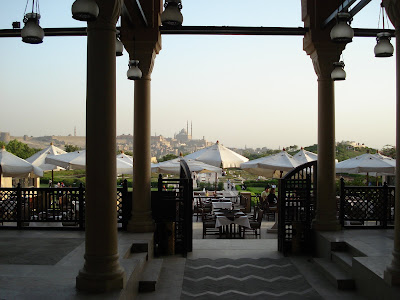
Al Azhar Park

Image
In the very heart of Cairo’s noisy and heavily polluted center, an unexpected oasis has been created, as is featured in this month’s issue of Saudi Aramco World , a daring green experiment linked to Cairo’s past. It is located on the site of a vast rubbish dump where for more than five hundred years residents had tossed away their garbage. The park is a marvelous gem, an Islamic garden, and Cairo’s green lung. The Aga Khan, Imam of the Ismaili muslims with family ties to Cairo’s Fatimid Dynasty of the 10th century, has been a main sponsor of the project. Work commenced in 1997, and in 2004 the park received its first visitors. It is amazing to read what the team of Egyptian, French, Italian, and American architects, engineers, and landscape specialists and horticulturalists uncovered when digging in the thirty meters of rubble.

Islamic Cairo

Image
I have left Cairo two weeks ago with plenty of new impressions. The city with its 20 millions or so, the incredible traffic with its, for Arab countries so typical, exactly two rules (rule number one: don’t let anybody in; rule number two: there are no other rules). Crowds in the streets rather reminding of mass demonstrations. The noise. The mixture of good and bad smells. And friendly people everywhere, deeply rooted in faith and trust in God despite touchable despair. I loved the heat and the rubble in the street. The enormous souqs. Very oriental, actually decaying, quarters amidst urban areas. Fancy park-like residential quarters, and incredible new ones with very-low quality buildings for the poor. I’ve noticed that the common tourist usually leaves the city after having seen Cairo’s main souq (or bazaar) Khan al-Khalili and the Egyptian museum only, to head for Luxor and Aswan. This is actually a pity. It took me about ten days to explore the city and visit only a small number o...

The City of the Dead

Image
Up to half a million people are living in one or the other of Cairo’s cemeteries. Egyptians have a millennia-old affinity to the dead. The necropolises of the Pharaohs have their contemporary counterparts in the cemeteries of the exploding city of Cairo with its supposed 20 million people. While the mausoleums’ guardians with their families have lived here for generations, new dwellers have arrived, homeless and poor, or even mad. The Northern Cemetery is a wonderful, peaceful quarter in the midst of bustling Cairo without any traffic except some donkey carts. There are small restaurants and even a police station. The cemetery is also home of the beautiful old mosque built by Sultan Qaitbey in the late 15th century. It is depicted on the 1 E₤ bank note.

The Mayhem

Image
Cairo, 22 June 2008

Exercises in Pyramids

Image
Well, I wasn’t in Giza. It was too hot in Cairo last week and the prospect of lining up in endless queues in the burning sun, hefty gate-money, claustrophobia, and, in particular, simply too many tourists prevented me from visiting. I have seen the Fab Three from the car when passing Giza on my way to another “exotic” place outside of Cairo, Birqash with its horrible camel market (I will report later), and the proximity of the pyramids to residential areas was in fact amazing. No, we went to Saqqara and Dahshur, further to the south. Saqqara is home of the first stone monument, the Step Pyramid. Here also a life-size limestone sculpture of the Pharaoh Djoser was found, who governed the country 2650 BCE when Imhotep, his later deified architect built this ingenious pyramid (I suppose it took more than one year, but that was the information given) which originally was totally encased with limestone. His Step Pyramid is about 60 meters high. Few tourists were strolling around the complex,...