Posts

Showing posts from January, 2009

Ghalamkar

Image
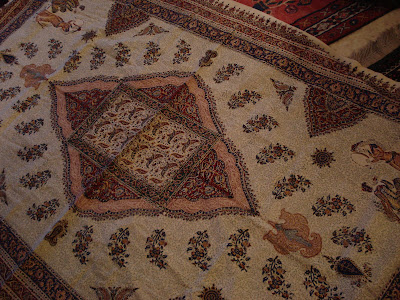
Hand-printed cloth can be seen everywhere in Iran (and you will also find them in Kuwait in the Iranian Market in Ray or downtown, in the Souq Mubarakia). They are used as bedspreads, tablecloths, or simply for wall decoration. Wooden blocks, or models, are used to print colored patterns onto beige cotton cloth in several design steps. The finest ghalamkar may later be painted. Old and antique pieces are highly sought after. They are not cheap at all. Although the (natural) colors have been fastened by washing already, I wouldn’t dare to remove the slight stain from these two pieces I recently bought in Iran. One has the design of a prayer mat and was surely used for that purpose. As you can see, the calligraphy on top interestingly mentions Muhammad after ’Ali!
Buyid Architecture in Esfahan

Image
Older than what is now visible in Esfahan’s Great Mosque (although the first mosque there was built in the 7th century) is what has remained of the Jurjir Mosque . The fragmentary façade of the Jurjir Mosque had been discovered during restoration work at Masjed-e Hakim in 1955. The fragment had been hidden for centuries behind a mud wall. The beautiful Hakim mosque itself is a Safavid mosque from the 17th century. The Jurjir façade is the only remains of a 10th century mosque which was commissioned by the Buyid (Buwayhid) vizier Al-Sahib ibn Abbad (d. 995), a Mutazilite scholar. The Buyid Dynasty, who ruled in Iraq and Iran, effectively brought the Abbasids era in Baghdad to an end. Although the Abbasids retained the caliphate, they were deprived of all secular power. Buyids were originally Zaydi, or Fiver Shi'as. They later began to lean closer to the nowadays dominating Twelver Shi'a branch of Islam. In general tolerant in religious matters, the Buyid rulers in Baghdad even ...

So What

Image
Barack Obama will not come up to our expectations. So what? Miles Davis, Kind of Blue , fifty years ago.

Al-Haram Al-Sharif

Image
The current, as ever marvellous, January - February issue of the Saudi Aramco World Magazine contains a virtual tour through the Dome of the Rock and Al-Aqsa Mosque in Jerusalem, a site of great significance for Muslims (and maybe Jews and Christians, as well). For the first time, I could see the intricate and intriguing calligraphic inscriptions on the inner octagonal arcade, which are considered as belonging to the oldest Islamic inscriptions ever. It contains, apart from verses from the Holy Qur'an, strong polemic against Christianity, while stressing at the same time the Qur'anic doctrine that Jesus Christ, the son of Mary, was a true prophet. German scholar and professor for semitic and arabic languages Christoph Luxenberg had recently claimed that the text may in fact point to the Christian origin of the building. From the January - February 2009 issue of Saudi Aramaco World : "One hundred and fifty years ago, in 1859, M. J. Diness made the first known photographs ...

Sola Tilbake

Image
Is it dawn or dusk? Well, probably both. Sun is back and quickly rising now. The equinox is already on March 20 this year, and another nine weeks later, the midnight sun will shine for two months. It is a strange part of the world. Mentalwise, I managed better this year during the dark period. One might get used to it.

At the Foothills of Karkas

Image
The new town and old village of Natanz have received considerable international attention since 2003 when the first centrifuges for Uranium enrichment had been installed in a huge subsurface complex close to the highway between Kashan and Natanz. The nuclear facilities, which are top on any list of possible targets for Israel’s and even the United States’ bunker busting weapons, can be seen when traveling by bus to Esfahan. Taking pictures is, of course, not allowed. Not so well-known is that especially the ancient village of Natanz is very beautiful and absolutely worth a visit. Tourists are rarely seen in the small bazaar in the center, where interesting handicrafts are sold. The other ‘must’ is, of course, the lovely Abyaneh at the foothills of Kuh-e Karkas, the 3800 meters high mountain massif in Central Iran. I have reported on a visit there in 2005 somewhere else on this blog. My host, the Dean at Khorasgan University in Esfahan, had invited me and some of his former students fo...