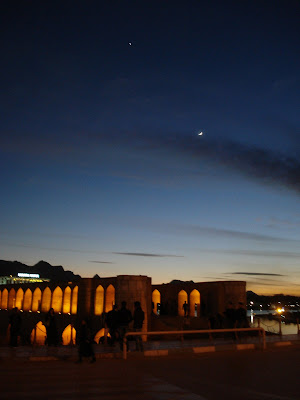
Si-o-Seh Pol at night in Esfahan is really a beauty. But if Venus, the crescent of the moon, and mercury are illuminating the scenery, it's just amazing. You have to click on the picture and carefully examine the inflated image to see Mercury in the center of the right side in the sky. I could watch the rapidly moving innermost planet on several evenings when recently visiting Iran. One obligation of my trip was to visit again the Jewish cemetery in Esfahan's vicinity. The 2000 years old site is difficult to find. At least on my map of Iran Linjan is not explicitly mentioned. Go to the southwest, the taxi driver will most probably know. In Linjan, which is a larger town, you should ask for the Jewish cemetery. We called a local by mobile phone who immediately showed and turned out to be a Muslim (!) guide of the site. He was a friend of the Jews in the town, he told us. I remembered last year's visit . The narrow room again showed recently burnt candles. Our guide immediate...
Kuwait’s Arab Times had attracted my attention to Esfahan’s gorgeous Great Mosque in an article in 2003. Unfortunately, I couldn’t find so far a webpage of the article which praised the wonders of Iran’s largest mosque and one of the most significant and finest buildings of the Islamic world. I visited the site the first time at my second trip to Esfahan in late spring of 2004. I took some pictures in the vast courtyard, soaked the peaceful atmosphere there, and watched the few visitors from Iran and elsewhere. I had forgotten about the many details of the article and faintly had read some of the notes in my travel guide. My second visit in late 2007 was driven by scientific interest. I had recently posted (at Freelance ) my rather amateurish studies and thoughts about a suggested ‘conceptual breakthrough’ in Islamic architecture and art in the late 15th century, i.e., quasi-crystalline tessellations, which had led to world-wide attention due to its publication in the Science magazine...
I have written about the two Kharraqan towers before, see here . Both had been heavily damaged in a 2002 earthquake. They are located about one km west to the village of Hisar-i Valiasr and 33 km west to Ab-i Germ on the Qazvin-Hamadan road in the Qazvin province. The towers are basically octagonal with a height of about 15 meters and a width of 4 meters. They are considered the earliest examples of double-domed buildings in Iran. Due to their extraordinary ornamental brickwork the Kharraqan towers belong to the finest Seljuq monuments found in Iran. Execution of artistic ambition directly relates to that of the Maraghah towers, see here. They were built by Muhammad b. Makki al-Zanjani in 1068 and 1093 CE. It is amazing that they had been discovered in the west not before 1963 by William Miller and described shortly afterwards by archeologists David Stronach and T. Cuyler Young Jr. The Kharraqan towers are tombs, and the occupants are most likely unknown Seljuq chie...


Comments